


Flipping the Script: Selling DFW Fixer-Uppers Faster With Virtual Staging & Pro Lighting
Transform 'hard-to-sell' North Texas distressed properties into irresistible investment opportunities using strategic real estate media.
Let’s have a candid conversation about the elephant in the living room. Or rather, the living room with the peeling 1970s wallpaper, the suspicious ceiling stain, and the violently green shag carpet.
As a DFW real estate agent, selling a pristine, move-in-ready new build in Southlake or a meticulously updated condo in Uptown is a relatively straightforward endeavor. The home does most of the heavy lifting. But selling distressed homes Dallas buyers might ordinarily scroll right past? That requires a distinct blend of strategy, psychology, and top-tier marketing.
Whether you are dealing with a gutted property in a historic district or an outdated ranch primed for a modern overhaul, marketing North Texas investment properties presents a unique set of challenges. Chief among them: buyer imagination is notoriously weak. When a prospective buyer or investor looks at a dark, dingy, half-demolished room, they don’t automatically see an open-concept chef’s kitchen. They see work. They see dollar signs. And all too often, they see a reason to click "Next."
However, the days of throwing up three dark, grainy iPhone photos of a distressed property with the caption "Investor Special!" are long gone. The modern Dallas real estate market demands a higher standard. To command top dollar and minimize days on market for a fixer-upper, agents are turning to a highly effective, one-two punch: professional architectural lighting and hyper-realistic virtual staging.
The Proof: Why Visual Strategy Matters for Fixer-Uppers
To understand the true ROI of professional media on a distressed property, we have to look at the data. In a recent analysis of 50 recent 'as-is' and distressed property listings across the Metroplex—focusing heavily on transitional neighborhoods and Oak Cliff real estate—the numbers revealed a staggering reality.
Properties that utilized high-end architectural lighting to showcase the home's "bones," paired with targeted virtual staging to illustrate post-renovation potential, spent 32% fewer days on the market than comparable homes marketed with standard, unedited photos. Furthermore, these visually optimized properties closed at an average of $12,500 over the initial neighborhood projections for similar fixer-uppers.
Why does this happen? It all comes down to cognitive anchoring. In real estate, a buyer’s first impression anchors their perception of a property's value. If their first visual anchor is a dark, depressing room, their perceived value plummets, resulting in lowball offers. If their first anchor is a brightly lit, virtually staged vision of what the home could be, they begin calculating their offer based on the home's future potential.
Here is exactly how top-producing DFW agents are utilizing these tools to master Dallas fixer-upper marketing, and how you can implement these strategies to dramatically boost your ROI on hard-to-sell listings.
Pillar 1: The Transformative Power of Professional Real Estate Lighting
When dealing with a property that needs love, bad lighting is your absolute worst enemy. Harsh, unmitigated shadows exaggerate every crack in the drywall, every scratch on the original hardwood, and every uneven texture on the ceiling. Conversely, an over-exposed smartphone flash flattens the room, creating a sterile, uninviting image that feels like a crime scene rather than a future home.
Professional real estate lighting is about much more than just making a room visible; it is about managing shadows, balancing color temperatures, and guiding the buyer’s eye to the structural potential of the space.
Flattening the Flaws
When we shoot a distressed property, our goal is not to hide reality—that leads to angry buyers at the showing. Instead, our goal is to present reality in its absolute best light. By using a combination of ambient exposures and precisely placed strobe flashes, we can fill in the harsh shadows that make empty, outdated rooms feel small and intimidating. Professional lighting illuminates the exact dimensions of a room, highlighting the square footage and the architectural layout (the "bones") rather than the superficial damage.
Correcting Color Contamination
Outdated homes are infamous for terrible color contamination. You might have yellowing incandescent bulbs overhead, blue daylight pouring in through a dirty window, and green light bouncing off the overgrown oak tree outside. This mix of color temperatures makes a room feel chaotic and dingy on camera. High-end real estate photography equipment and professional post-processing neutralize these conflicting colors. We ensure the whites look crisp and the natural light feels inviting, immediately elevating the subconscious perceived value of the home.
Pillar 2: Leveraging DFW Virtual Staging Services
Once the property is beautifully lit and accurately captured, the second phase of the transformation begins. Empty, distressed rooms offer no scale. A buyer looking at a 15x15 gutted living room often cannot conceptualize whether a sectional sofa will fit. This is where strategic virtual staging steps in as the ultimate tool for selling distressed homes Dallas investors and flippers are hunting for.
However, virtual staging for a fixer-upper requires a different approach than virtual staging for a clean, vacant new-build.
Selling the Future, Not the Present
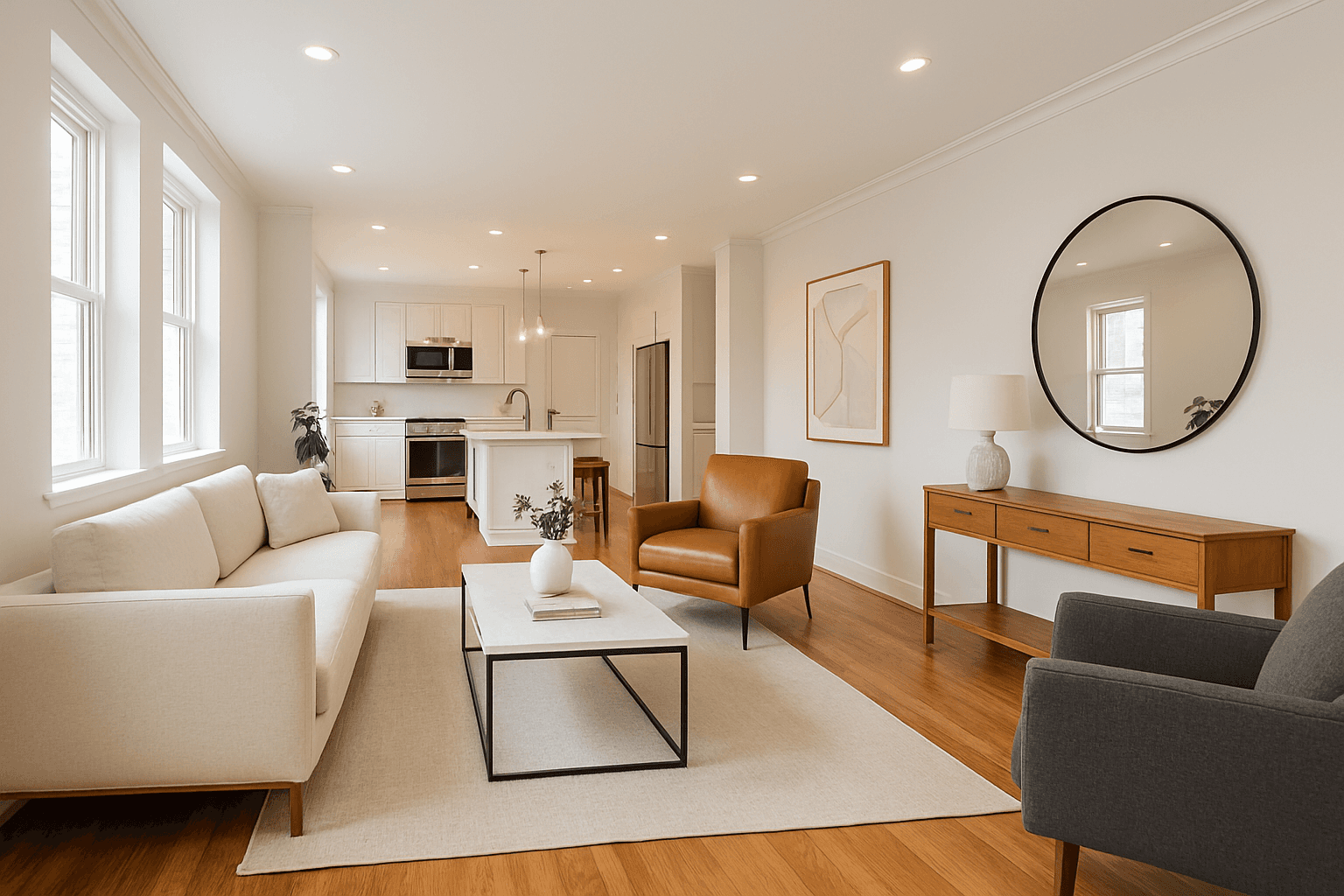
Standard virtual staging adds furniture to a clean room. Fixer-upper virtual staging (sometimes called virtual renovation) actually replaces outdated flooring, updates cabinet colors, or removes virtual clutter to show the pristine final product.
When utilizing DFW virtual staging services, you provide the buyer with a visual roadmap. You are effectively saying, "Yes, the kitchen currently has green linoleum and broken cabinets, but look at this rendering of how a $25,000 renovation completely modernizes the space."
Tailoring to the Neighborhood
The beauty of virtual staging is its adaptability. If you are selling an investment property in the M Streets, your virtual staging can reflect a transitional, modern-tudor aesthetic that appeals to young Dallas professionals. If you are marketing a mid-century tear-down in Richardson, the staging can lean into trendy, mid-century modern minimalism. You aren't just selling the house; you are selling the localized lifestyle that the buyer desperately wants to achieve.
Pillar 3: The Curb Appeal Cheat Code
The exterior of a fixer-upper is often just as daunting as the interior. Dead grass, peeling exterior paint, and an overgrown front walkway can instantly repel buyers before they even click through the gallery. While you cannot virtually plant a 50-year-old oak tree without misleading a buyer, you can use atmospheric lighting to completely change the emotional resonance of the home's exterior.
This is where the magic of the twilight hour comes into play.
A twilight shoot captures the home during the brief window just after sunset. The sky turns a brilliant mix of deep blues, purples, and oranges, and the interior lights glow warmly through the windows. This high-contrast, deeply emotional lighting setup naturally obscures dead landscaping and peeling paint, drawing the buyer's eye directly to the architectural silhouette and the warm, inviting glow of the home.
By integrating stunning Twilight Photos into your marketing package, you create a "scroll-stopping" hero image for the MLS and social media. When an investor or prospective homeowner is scrolling through dozens of brightly lit but fundamentally ugly "as-is" properties, your beautifully crafted twilight exterior will stand out like a diamond in the rough. It forces them to click, which is the very first hurdle of Dallas fixer-upper marketing.
Pillar 4: Budgeting for Distressed Property Marketing
One of the most common objections agents have when marketing North Texas investment properties is the marketing budget. “Why would I spend money on professional photos and staging for a house that is going to be gutted anyway?”
The answer is simple: ROI. You aren't spending money on photos to impress the current seller; you are spending money on a marketing strategy to maximize your commission, shorten your days on market, and build your own brand authority as an agent who treats every listing with white-glove service.
That being said, you don't necessarily need a sprawling, 50-photo magazine spread for a 1,200-square-foot Oak Cliff bungalow that needs a total rehab. The key is strategic, high-impact media. Focus on the core structural areas: the exterior, the main living space, the kitchen footprint, and the primary bedroom.
For smaller investment properties or tight budgets, an efficient photography package combined with a handful of virtually staged photos is the perfect sweet spot. Utilizing a streamlined service like our Mini Property Photography allows you to capture the absolute highest quality, professionally lit images of the home's core spaces without over-extending your marketing budget. You get the flawless architectural lighting and color correction required to make the space look its best, giving you the perfect foundation for your virtual staging transformations.
Executing the "Before & After" Strategy
Once you have your professionally lit "before" photos and your hyper-realistic virtually staged "after" photos, it is all about execution. How you present this media matters just as much as the media itself.
The Hero Image: Always lead with your strongest photo. If you invested in a twilight photo, use it as the primary MLS photo. If the exterior is truly unsalvageable, lead with a virtually staged, brightly lit image of the main living area.
The Side-by-Side: On the MLS, always place the virtually staged photo immediately before the actual, current-condition photo of that same room. Include a clear watermark or text overlay on the rendering stating "Virtually Staged / Potential Layout." This ensures transparency while keeping the buyer anchored to the property's potential.
Social Media Storytelling: Fixer-uppers are absolute gold for social media marketing. People love a transformation. Create Instagram Reels and Facebook carousels showing the "Current Reality" wiping away to reveal the "Virtually Staged Future." This type of engaging content not only attracts buyers for that specific property but also serves as incredible lead generation for other investors looking for a savvy, modern real estate agent.
The Property Narrative: Your MLS description should explicitly reference the media. “Discover the incredible potential of this Oak Cliff gem. View our virtually staged renderings to see how a modern, open-concept renovation can transform this solid-bones property into a masterpiece.”
Elevate Your Real Estate Brand
Selling distressed homes Dallas buyers are skeptical of doesn’t have to be a frustrating, drawn-out process filled with lowball offers and endless days on the market. By shifting your perspective and upgrading your marketing arsenal, you can turn your hardest-to-sell listings into your most compelling case studies.
Professional real estate lighting ensures the property is seen in its truest, most spacious form, while DFW virtual staging services provide the visionary roadmap that buyers desperately need. Together, they form an unshakeable strategy for marketing North Texas investment properties.
At The Home Exposure, we specialize in providing Dallas-Fort Worth agents with the high-impact visual media required to stand out in a saturated market. Whether you are listing a luxury estate in Frisco or a promising fixer-upper in Oak Cliff, we deliver the lighting, the angles, and the virtual technology to help you flip the script, command attention, and close the deal.
References